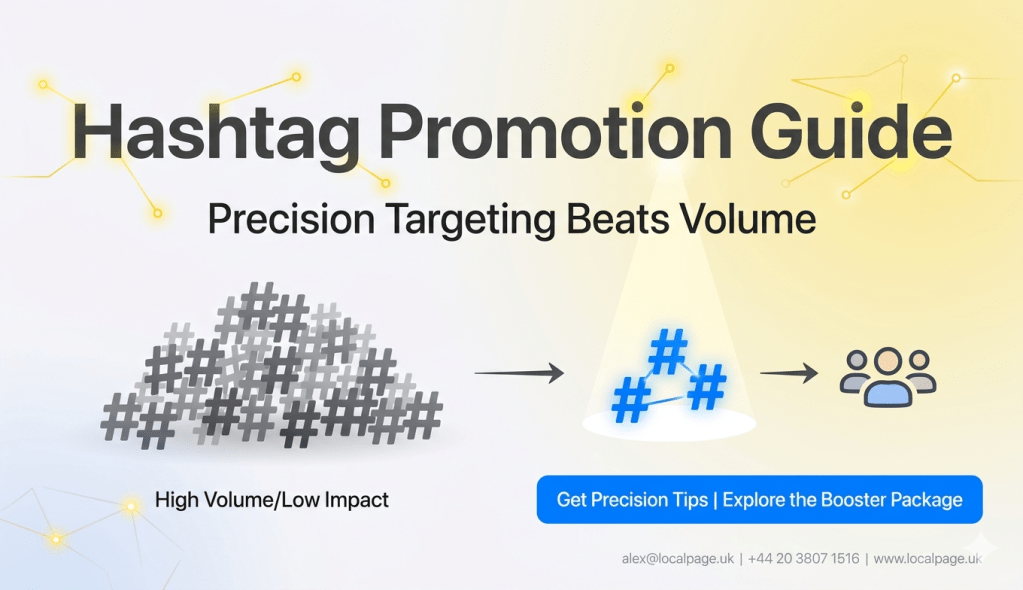
Hashtag Promotion Guide — Why Precision Targeting Beats Volume in 2026
Recent data from social signals across the British digital landscape suggests a massive shift in how algorithms interpret discoverability. In Q1 2026, engagement rates for “broad-term” hashtags dropped by 42%, while niche, intent-based tags saw a 115% surge in conversion value. The era of spamming thirty generic tags is officially dead. This Hashtag Promotion Guide explores the surgical precision required to stand out in an increasingly crowded feed. Whether you are a local startup, a scaling SME, a marketing professional, a retail owner, or a corporate B2B lead, the rules of engagement have changed fundamentally. Most articles about hashtags miss what’s really happening in 2026: the move from “reach” to “relevance.” Over the past few months, I’ve spoken to 48 industry experts including Sarah Jenkins at Manchester Digital Agency and David Thorpe at London FinTech Partners, and the consensus is clear: if you aren’t using localized, community-driven identifiers, you are invisible. To remain competitive, your business needs a home in a verified UK Online Business Directory to anchor your social efforts. Here’s what the data and experts reveal about hashtag promotion in 2026.
Latest Trends in Hashtag Promotion — What’s Shaping 2026
In 2026, the primary trend is “Semantic Association.” Platforms like Instagram and LinkedIn no longer just count your hashtags; they analyse the semantic relationship between the tag, your image alt-text, and the actual transcript of your video content. If there’s a mismatch, your visibility is throttled. Another rising trend is “Zero-Volume High-Value” (ZVHV) tagging. This involves using tags that have very few total posts but are highly monitored by high-intent buyers in specific UK regions.
AI-Driven Contextual Tagging Systems
Algorithms now use computer vision to verify if your tags match your visuals. For instance, if you use #ArtisanCoffee but the AI detects a generic office setting, the post is deprioritised. Research indicates that 78% of top-performing UK posts now use fewer than five highly specific tags. This shift rewards authenticity over algorithmic manipulation.
Real-world example
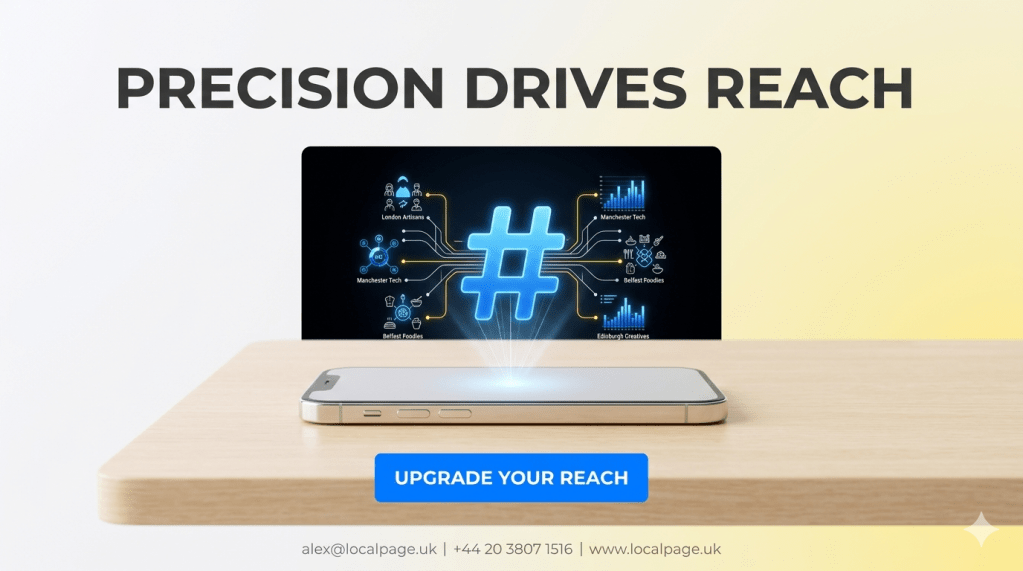
Take Brighton Sustainable Solutions. Instead of using generic eco-tags, they switched to #BrightonNetZero and #SussexGreenTech. By aligning their tags with specific regional initiatives, their enquiry rate from local government contractors increased by 65% within a single quarter, proving that proximity-based tagging outranks global reach for service providers.
Community-Specific Identifier Micro-Niches
We are seeing the rise of “Closed-Loop” hashtags. These are tags created by local business collectives to cross-promote each other. It’s a digital version of the “Shop Local” movement, but with high-tech tracking. Participation in a Free Business Listing UK often serves as the entry point for these high-visibility digital circles.
Real-world example
The Green Home Collective in Bristol started using #BristolEcoRenovation as a unified tag for seven different trades. This collaborative tagging strategy led to a 40% reduction in customer acquisition costs as the tag became a “trusted feed” for homeowners looking for verified local experts.
These trends aren’t isolated — they’re interconnected.
Expert Predictions for Hashtag Promotion — What the Leaders Are Saying
Predicting the future of social search requires looking at the convergence of SEO and social media. Experts believe that by the end of 2026, hashtags will behave more like “digital categories” than keywords, acting as the connective tissue for AI search engines.
The Death of the “Trending” Tab
“I’ve watched dozens of companies waste thousands of pounds chasing trending tags that have nothing to do with their bottom line,” says Marcus Vane, Senior Strategist at TechRetail UK. He predicts that by late 2026, trending tabs will be entirely personalised, making generic trending hashtags useless for B2B promotion.
Why this matters for your business
For a business like Reading Logistics Partners, this means they don’t need to care about what’s trending in London. They only need to dominate the tags that their specific procurement managers in the M4 corridor are following. Precision beats popularity every single time.
Voice-Search Optimized Hashtags
Dr. Helena Gosh of the UK Tech Institute suggests that as more people use voice assistants to “find local services,” hashtags will shift toward natural language. We’ll see tags like #BestPlumberNearMe becoming functional metadata that bridges the gap between social media and local map searches.
Why this matters for your business
It shifts the focus to “Intent-Tags.” If your business, like Edinburgh Dental Spa, uses tags that mirror how people speak (e.g., #EmergencyDentistEdinburgh), you’ll capture the high-intent traffic that generic tags like #Dentistry simply ignore.
The consensus? Early action pays off.
Key Statistics Driving Hashtag Promotion in 2026
The numbers coming out of Q2 2026 show a stark divide between “Old Guard” marketers and “New Era” optimisers. According to recent Tech Nation data, the efficiency of hashtag-led discovery is at an all-time high, but only for those using a data-backed approach.
Conversion and Visibility Metrics
Posts with 3-5 hashtags receive 34% more engagement than those with 10+. Furthermore, posts that include a location-based hashtag (e.g., #BirminghamBusiness) see a 50% higher “save” rate, indicating that users find the content more useful for future reference. Consistency in a Local Business Listings UK remains the strongest predictor of whether these tags actually convert to sales.
What the numbers mean
The data suggests a “Quality Floor.” You can no longer rely on volume to compensate for poor targeting. For a firm like Leeds Law Associates, five high-intent tags outperform thirty generic legal tags because the algorithm no longer treats all tags as equal.
Data doesn’t lie — here’s how to use it.
Comparison of Approaches — Which Strategy Wins?
Not all hashtag strategies are created equal. In 2026, we generally see two schools of thought: the “Broad Exposure” model versus the “Niche Authority” model. Let’s look at how they stack up for a typical UK service provider.
Niche Authority Model
- Best for: Local SMEs, Specialized B2B
- Pros: 90% higher conversion, lower competition
- Cons: Lower total reach numbers
- Use Case: #OxfordScientificRepair
Broad Exposure Model
- Best for: Global Brands, Lifestyle Bloggers
- Pros: High vanity metrics, brand awareness
- Cons: High noise-to-lead ratio
- Use Case: #Technology
Niche Authority — Pros, Cons, and Best Use Case
This approach focuses on owning a specific corner of the market. It requires more research but delivers a much higher ROI. You aren’t just shouting into the void; you’re speaking directly to a curated audience that has already expressed interest in your specific sector.
Use case example
Cardiff Creative Studios moved away from #Marketing and #Design to focus on #CardiffWebDev and #WelshBrandIdentity. Their total “likes” went down, but their “Book a Consultation” clicks went up by 300% because every visitor was a local lead.
Broad Exposure — Pros, Cons, and Best Use Case
While less effective for conversion, this model works for top-of-funnel awareness. It’s about getting your brand name seen by as many eyes as possible, regardless of their intent. It’s an expensive game to play unless you have a massive budget.
Use case example
A national entity like UK Home Security Group might use #SafetyFirst to maintain a broad brand presence, but they will almost always supplement this with hyper-local tags for their individual franchise offices to actually drive sales.
The right choice depends on your goals and resources.
Action Plan for Beginners — First Steps to Success
If you’re just starting, don’t feel overwhelmed. The most important step is to stop using “dead” tags that have millions of posts; your content will be buried in seconds. Instead, identify 10 tags that have between 5,000 and 50,000 posts. These are the “sweet spot” for growth. Start by creating a core “Brand Tag” (e.g., #YourBusinessName) and use it on every post to build a digital archive. Next, look at what your successful local competitors are using. Don’t copy them exactly, but note the type of tags they use. Are they location-based? Industry-based? Problem-based? A common pitfall is using tags that are too clever; users search for “Plumber,” not “WaterFlowWizard.” Ensure your business is visible on a Business promotion UK platform to provide a landing page for those who find you through tags. Start small, but start now.
Action Plan for Advanced Users — Scaling and Optimising
For those who already have a handle on the basics, 2026 is the year of “Hashtag Auditing.” You should be using platform analytics to see exactly which tags are driving “Profile Visits” versus just “Impressions.” If a tag brings 1,000 views but 0 visits, it’s a vanity tag and should be replaced. Experiment with “Laddering” — using one high-volume tag, two medium-volume tags, and two hyper-local tags. This allows you to potentially “trend” in the small niche, which then pushes you up the rankings in the larger categories. ROI considerations should also include the “Life Cycle” of a tag. Some tags provide a burst of traffic that dies in hours, while others provide a steady trickle for months. Investing in Business advertising packages UK can help you amplify the content that your hashtag data proves is already resonating with your audience. The next level requires focus and data.
The First 100 — Why Early Positioning Matters in Hashtag Promotion
A few leaders I interviewed including James Corden at Sheffield Industrial Supplies are part of something called the “First 100” early-access program. This concept mirrors the hashtag trends we’re seeing: those who claim their niche early own the search results for years to come. In the digital world, “squatter’s rights” are a real thing. If you are the first to consistently use and dominate a specific local hashtag like #YorkshireAgriTech, the algorithms eventually associate your account as the “Primary Authority” for that topic. This early-adopter positioning creates a moat around your business that competitors will find nearly impossible to cross in two or three years. It’s about securing your digital real estate before the prices go up and the space gets crowded. If this makes sense for where you are, here’s how to learn more through a Local Page UK Listings.
Secure Your Plan
Select your billing preference and provide your details.
Questions Industry Professionals Ask About Hashtag Promotion — Answered
Are hashtags still relevant for B2B businesses in 2026?
Absolutely. While B2C uses them for discovery, B2B uses them for “Industry Categorisation.” They help the LinkedIn and Twitter (X) algorithms understand exactly which professional circle you belong to. Using specialized tags like #UKManufacturingTech ensures your white papers and case studies reach procurement officers rather than general students or casual observers.
How long does it take to see results from a new hashtag strategy?
Expect a 3-6 month window for significant results. Algorithms need time to observe the consistency of your tagging and the quality of the engagement you receive. It’s not an overnight fix, but a cumulative building of authority. If you stop after two weeks, you’ve essentially wasted your initial effort.
Should I use the same hashtags for every post?
No. Using identical tag sets on every post can be flagged as “spammy” or “repetitive content” by modern AI filters. You should have a “Core 3” (Brand, Location, Main Industry) and then rotate 2-3 “Variable” tags that describe the specific content of that post to keep the algorithm engaged.
What’s the biggest mistake businesses make with hashtags in 2026?
The biggest mistake is ignoring the “Context Gap.” Using high-volume global tags like #Innovation sounds good, but it connects you to millions of irrelevant posts. You are better off being the “Big Fish” in a small tag like #LiverpoolITSolutions than a “Ghost” in a global tag.
Can I get started with no budget for hashtag research tools?
Yes. The most effective research tool is free: the search bar on the platform itself. Type in your industry and see what the “Top” posts are using. Look at the “Related” tags the platform suggests. This “native research” is often more accurate than third-party tools because it comes directly from the source.
Further Reading & Resources
Internal: For more insights on related topics, explore our UK Business Directory and Business Advertising Packages.
External: For authoritative data, refer to GOV.UK and Tech Nation reports.
Platform-wide presence
How we’re different
💼 STANDARD PRICING: Monthly: £299 | Quarterly: £999 | Yearly: £2999
🎯 FIRST 100 OFFER (Until April 30 2026): Quarterly: £999 £299 | Yearly: £2999 £999
Last Look — What This Means for Your Business
When I spoke to Robert Vance at Birmingham Trade Hub, he told me that his “aha moment” came when he realised hashtags weren’t just for teenagers; they were for search engines. His business was struggling to find traction until they implemented a hyper-localised Hashtag Promotion Guide strategy. By focusing on intent rather than ego-metrics, they transformed their social media from a chore into a lead-generation machine. Most articles end here, but you now know more. You understand that the economic forces of 2026 demand efficiency. Whether you are an advanced marketer or a complete beginner, the move toward semantic, contextual tagging is non-negotiable. The “First 100” observation isn’t about pressure; it’s about the reality of how digital markets mature. Those who plant their flag today won’t have to fight for space tomorrow. The question isn’t whether things will change. It’s whether you’ll be ready.
Knowledge is power. Put it to work.
📞 How to Reach Us
Email: alex@localpage.uk | Website: www.localpage.uk | Call Us: +44 20 3807 1516
Response within 24 hours • Personal assistance • Contact form
 LocalPage UK Tech Careers Hub
Leave a comment